
The Limburg Whisky Fair 2023 turned me into a sample hoarder. That’s when I really realized the breadth whisky samples one could get a hold of. And I started buying lots of samples online, too. And this is how I’ve been able to review well over 300 different whiskies on this blog so far.
But I soon realized that some samples I had got in Limburg tasted strange; a very particular cardboard taste. And the samples affected were mostly those from Malt Harry’s big box of samples, probably filled long ago and carried from one whisky show to another. That is the fear then, that the golden treasure of samples I accumulate, will turn to cardboard. But how likely is this, and what can be done? An experiment was needed.
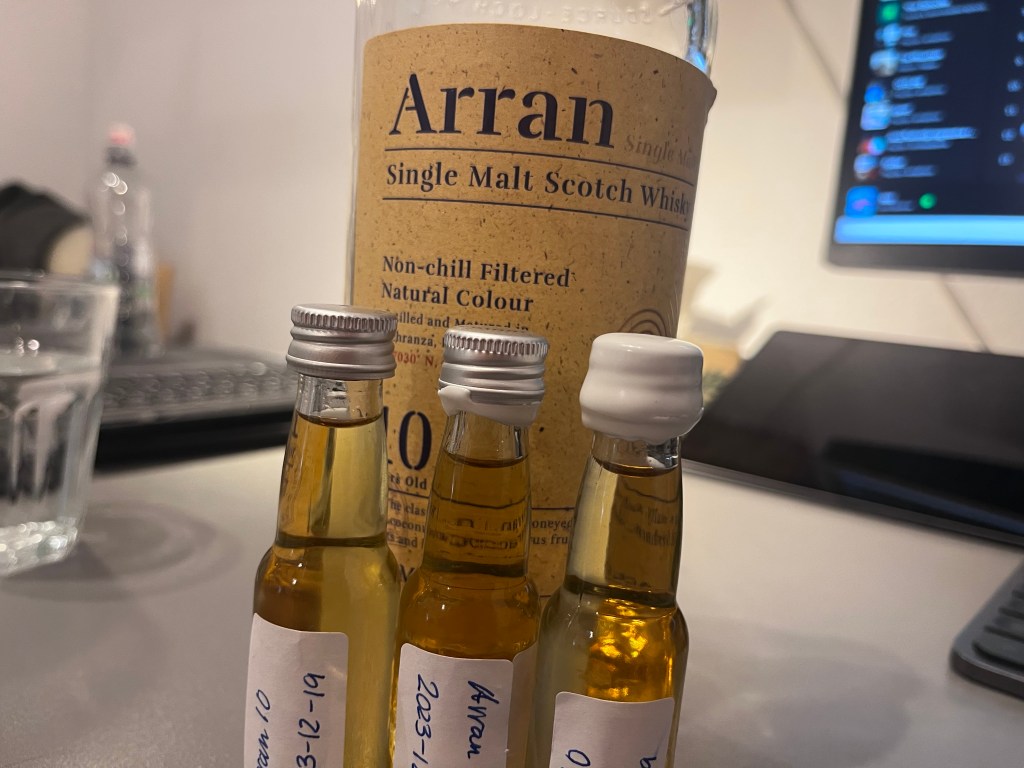
On December 19, 2023 (20 months ago) I filled three sample bottles with Arran 10, from a bottle in my stash. A flavourful but mild-mannered whisky, that should not mask the cardboard flavour if it’s there. The first sample just had the screw top. My hypothesis is that these are not tight enough to prevent slow oxidization over time, and that’s causing the off-note. So what if I seal the screw top with wax (see cover image)? The second sample I sealed only at the bottom of the cap, and the third sample has the entire cap waxed in (though I don’t really see why this should make a difference). Let’s say it’s a control. Lastly, I just now poured a sample from the Arran bottle, which has been sitting a relatively low fill-level for a long while. I expect it to be different from the sample, though not with a “cardboard defect”.
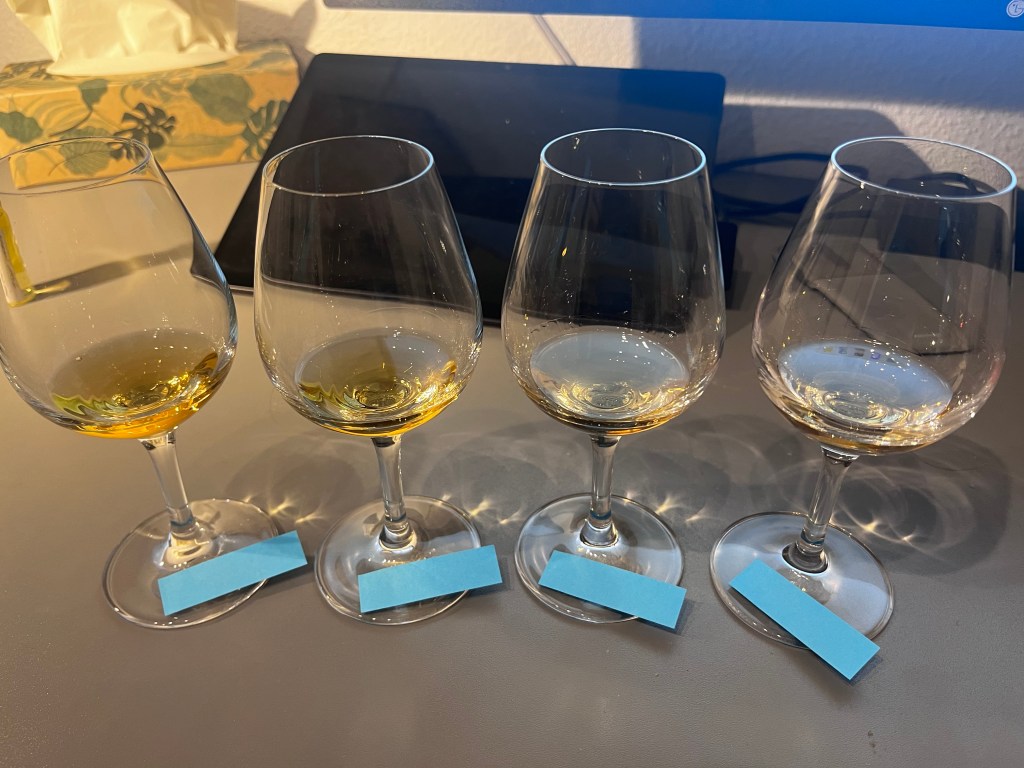
On the underside of the blue labels stuck onto glasses is the identifier of the sample. I have shuffled the glasses around, and this will be a blind tasting. The goal is 1) to tell if there are differences between the glasses (on the nose or palate), and 2) to detect particular if there is anywhere a cardboard note. After the first round of comparing the glasses, I will write down my observations for samples x in round 1: 1.1, 1.2, 1.3, 1.4; add a new hidden label to each glass with this identifier; shuffle again, and enter round 2; and so on, for as long as meaningful. The point of this is to test that a difference I detect between two glasses is in fact systematic, and that I pick out this difference in several independent trials.
Round 1
I think I can nose a real difference, but I’m not rock sure. 1.1 and 1.4 have more fruit and vibrancy than the other two, especially 1.2 which is more flat.
Moving on to tasting, 1.1 tastes nice, nothing off. 1.2 is also fine, but maybe a little less generous. 1.3 is similar. On a second pass, the differences shrink, though I’d tentatively say 1.1 was a little juicier, and 1.2 a little flatter.
Round 2
So now the glasses have been shuffled again; I don’t know which is 1.1, 1.2, etc.
2.1 has really nice pears and tropical fruits. They are not as strong in 2.2, where I notice more the vanilla. With 2.3 and 2.4 I get uncertain. Based on the nose I would think 2.1 = 1.1 or 1.4 with very high probability, the other one of those two is probably 2.3; I think 2.2 = 1.2, and 2.4 = 1.3 by process of elimination; but on the whole I’m uncertain except 2.1.
Palate: 2.1 nice, 2.2. a bit more bitter. 2.3 and 2.4 are harder to say anything about the differences. Let’s move to the next round, which I will declare the last one.
Round 3
The glasses have now been about for a while and are getting empty; this does change the experience in each glass.
The differences on the nose are now much less clear. I would guess 2.1, such a standout in round 2, is either 3.1 or 3.4.
On the palate I’m less convinced that 3.1 is the better sample. But even less convinced by 3.2 or 3.3. No cardboard notes per se, but I imagine the inklings of an oxidized tiredness. 3.4 was quite convincing on the palate.
Final guess
I have to admit that I expect to be completely wrong. It was hard to see a consistent pattern through the rounds. The strongest signal of a difference I had was the nose on 2.1. What I can confirm is that all samples were fine, no cardboard defect, which is very distinct.
My a priori expectation is for the two waxed samples to be indistinguishable, and possibly the best preserved, if the bottle has oxidized too much. On the other hand, the bottle could be best if it has reached just the right amount of oxidization, but I’ll go for the former hypothesis. For sure, the unwaxed sample should be worst.
I’ll venture to guess that 1.1 & 1.4 are the two waxed samples, so is 2.1. Then 1.2, 2.2, 3.3 are the no-wax.
Results and discussion
| Round 1 | Round 2 | Round 3 | Guess | |
| Bottle | 1.4 | 2.1 | 3.1 | by exclusion |
| Sample—no wax | 1.2 | 2.2 | 3.2 | 1.2; 2.2; 3.2 or 3.3 |
| Sample—partial wax | 1.3 | 2.4 | 3.4 | 1.1 / 1.4; 2.1; 3.1 / 3.4 |
| Sample—full wax | 1.1 | 2.3 | 3.3 | 1.1 / 1.4; 2.1; 3.1 / 3.4 |
It would seem I could pin the no-wax sample, though it wasn’t an obvious outlier. The one with the very convincing nose is round 2 was the bottle, and my sense that 1.4, 2.1, 3.1 were likely to be the same was correct, though my guess that these were the waxed samples was wrong.
Now I have a little left of each sample, and I will try without the blindfold. The differences are not big, but on the nose especially there is an edge for the bottle.
Overall I would conclude that an unsealed cap does lead to a flattening of the whisky, though even 1.5 years hence the effect might be not very noticeable. Waxing seems to work, but resting in a bottle, even at low fill level, seemed the best — at least for this whisky. I can’t determine whether the waxed sample has perfectly preserved the state of the whisky as when bottled, and the bottle has continued to change (for the better), or if it’s the other way around, and the sample has somewhat deteriorated while the bottle remained little changed (it might not have been opened at all since the samples were prepared).
The upshot is that I can rest quite assured that my samples generally are not spoiling at a fast rate. Waxing those that are not sealed with a plastic topper seems a good idea that I will continue with. What is likely of most importance is the storage conditions. Though the temperature and humidity in my apartment varies with the seasons, the samples are kept in the dark and are not being manhandled.
Reviews!
Time to actually review the whisky, not just looking for minute differences between the samples. Oh, and as a reward for all the toil, I’ll end with a rather luxurious sample of mature Arran. I’m actually not finding the exact bottle for it on WhiskyBase (I order the sample a long time ago). But I will precede under the assumption that it is comes from cask 96/1306, which is one that was split between many German retailers/private persons, matching the ABV and vintage written on my sample.
Arran • 10yo • 46%
Scotch Single Malt • Bourbon and etc casks • Natural Colour & Unchillfiltered • €38 • WB🔗 (or other batch)
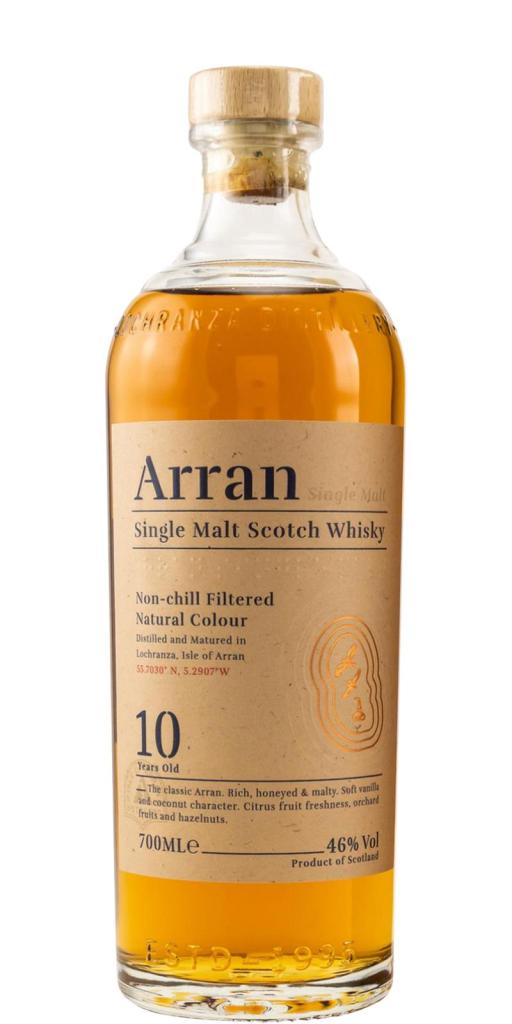
Tasting notes from a bottle
Nosing
Very fruity and confectionary: lots of ripe pears and apples, tropical fruits, toffee, vanilla, honey, and a little smoked butter.
Deliciousness
Fun factor


Sipping
Sweet on the palate, quite viscous and oily. Clean malt, honey, and toffee notes. A little bitterness in the development, and aftertaste returns to fruits, gooseberries, and oily oak juice.
Deliciousness
Fun factor

Overall
A great core range whisky at a fair price. That’s why I bought the bottle, to have as the first dram in a whisky tasting I organized some time ago. On the whole, I would say a bit too honeyed for my full satisfaction, but I can fault nothing in the quality here.
Great Value
⭐
Arran • 19yo (1996) • 52.5% • Private Bottling
Scotch Single Malt • Sherry puncheon • € ? • WB🔗 (probably from that shared cask)
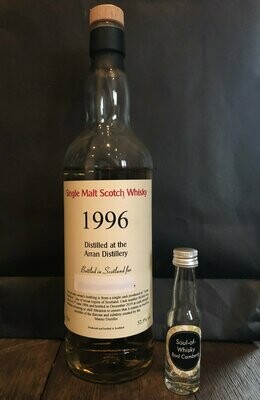
Tasting notes from a 2cl sample bottle
Nosing
Light and grassy, with some milk chocolate, gorse flower, shea butter, biscuits, toasted oak and mineral. Overall a little closed, and notable alcohol. With water I tease out some sherried notes, red currant, plum, cinnamon; a Christmas spice vibe grows stronger.
Deliciousness
Fun factor
Sipping
Medium-sweet, and a little savoury. I’d say a malty and biscuity dram, with an assortment of tart berries and plum.
Deliciousness
Fun factor
Overall
It’s good well-matured oak juice, but there’s not any standout flavour note, or point of uniqueness and character. Though the sweet kisses of the 10yo might have more liveliness, we find rather more dignity here.

 DuckDrams
Leave a reply to Killing spree – DuckDrams Cancel reply