

Glenfarclas stands out for many reasons. It’s one of only a few family owned distilleries in Scotland. It’s one of only three Scotch distilleries to direct-fire their stills, supposedly contributing to the ‘weight’ of the spirit, so suitable for long maturation in sherry casks. They market themselves a Highland malt, rather than a Speyside malt, although, technically, all Speysiders are Highlanders.
I visited Glenfarclas distillery back in 2019 with the WOLS spring trip. Glenfarclas have an excellent visitor centre and, quite memorably, a tasting room fitted with the décor of an old ship.
Today I will sample the entire core range, the 12, 15, 21 and 25yo, and a couple of specials, the 30yo and a 1988 vintage. For this review I find a “narrative” approach more suitable than attempting a full self-contained review for each sample.
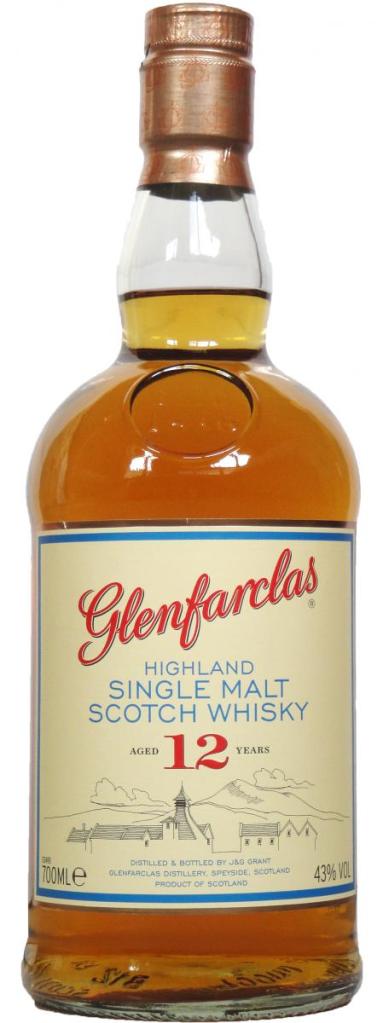
First, we have the Glenfarclas 12yo 43%, which I tried a sample of in July. My notes: Fresh fruits on the nose (orange zest, fresh grapes), soft oak and baking spices (vanilla, cinnamon). Some spicy oak on the palate, otherwise quite gentle and sweet; caramelized sugar in the finish. Rather generic Speyside profile that does not do much for me, but it is a level above the cheaper single malt one would find in supermarkets. Not a bad starting place for whisky beginners.
Stepping up to the Glenfarclas 15yo 46%, I’ve had a good while to get acquainted with it. I opened it for a whisky tasting I arranged for my colleagues in early spring. My notes from July: The nose is fresh, fruity, and sweet; orange marmalade, tinned tropical fruits (litchi), and ripe pear. Freshly ground coffee beans, cinnamon, nutmeg, and some dusty oak. Rich in taste, sweet but not too sugary; dried figs, some leather, and woodfire smoke and oak spice.
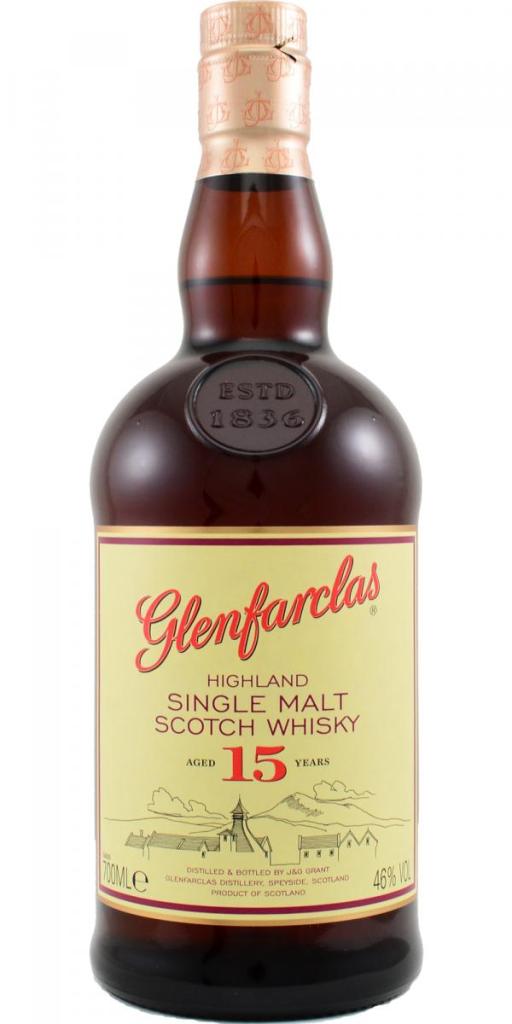
Many of the notes from the 12 and 15yo feature throughout the Glenfarclas line (and I shall not constantly repeat them), in particular the orange note (for me in the form of the Swedish “Trocadero” soda), red apples, and oak spice (e.g. cinnamon). But the 15yo has a familiar/generic sherry-butter-vanilla-toffee character that is not so intense in the 21, 25, and 30 year old.
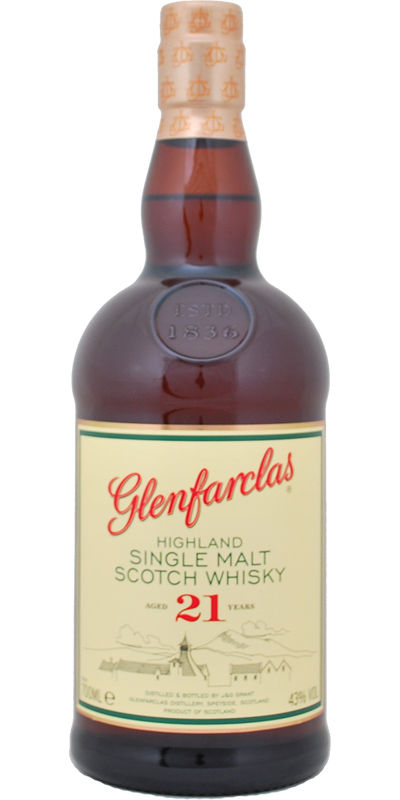
Putting my nose into the Glenfarclas 21yo 43% the character is indeed somewhat different. I’ve had a while to familiarise myself with this 200ml mini-bottle too, which today (November) is almost finished. Prunes, sultanas, red apples, and gooseberries are more prominent. More of a white dessert wine impression. On the palate I get dried mulberries and Inca berries and walnuts, which ride out a long and satisfying finish. Maybe the vaguest whiff of truffle too?
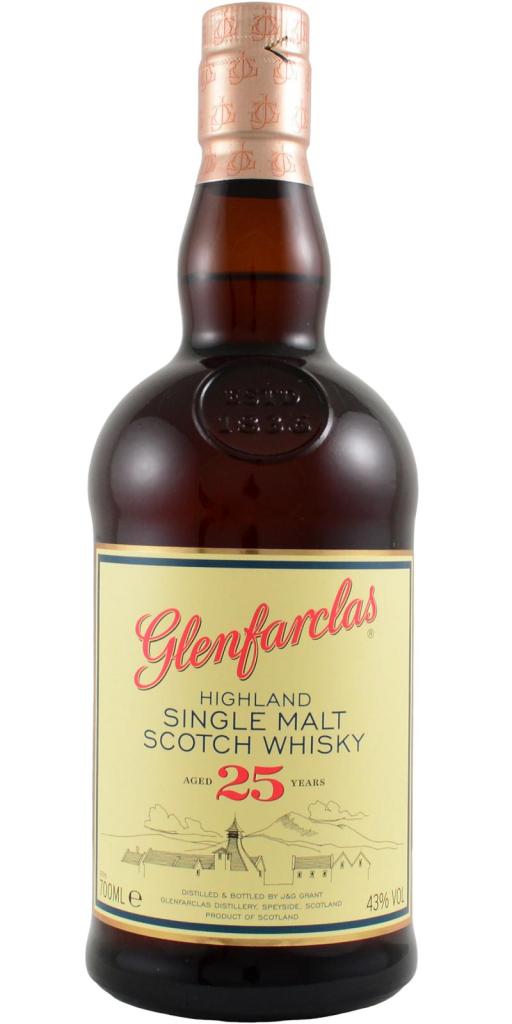
The Glenfarclas 25yo 43%, of which I have a but 3cl sample (received as a gift-with-purchase), brings back some vanilla, and enhances the fruits; some dried banana, in particular is present. Compared to the 21yo, there is more woodsmoke (beech?) on the palate, a little pipe tobacco, and a slightly minerally, beach pebble note. The long finish is again of dried berries, gooseberry in particular. Just to be clear, neither the 21yo or 25yo are dry, but rather sweetish and succulent.
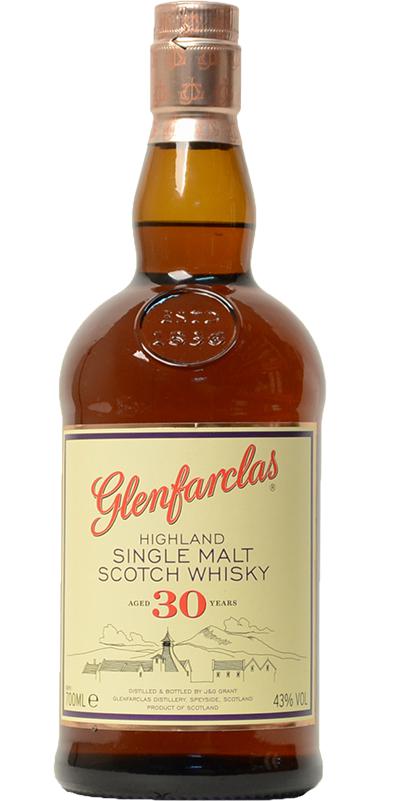
And so is the Glenfarclas 30yo 43%, a 3cl sample bought at a half-price sale for £30, as I recall. The nose here (after time and a drop of water) is a tad more generous than the 21 & 25yo, and pushes more on the canned tropical fruit aspect. On the palate, the smoke is somewhat more to the fore than the predecessors; also a hint of iodine.
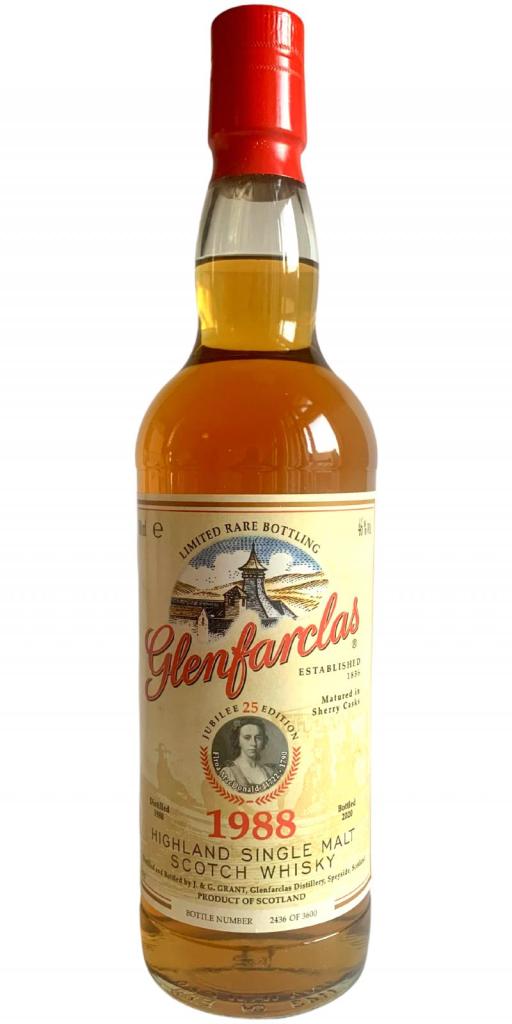
Last, and sadly, least, we have the Glenfarclas 31yo (1988) “Flora MacDonald” 46% (link). Great nose, slightly smokier and more vinous/perfumy than the rest. Trocadero galore, and ginger ale. Indeed, great nose, but there’s mini-bottle defect / wet cardboard on the palate. I had stored this 2cl pour in a 3cl mini-bottle. Although I tried to put some Argon gas into it to stave off the over-oxidation, it seemed my effort was in vain, and the sample did not survive its half-year under these suboptimal conditions…
Let’s consider value for for money. I would say there is a significant improvement in the experience from the 12yo to the 15yo. The latter is well worth the €43,50 I paid (Oct 2022) and with that low price, there’s no reason to settle for the 12yo. To my horror, it seems the 15yo today (Nov 2023) cannot be found for less than €63, while the 12yo sits around €35-40 (whisky.de/shop has €50 for the 12yo and €80 for the 16yo – yikes! It’s not looking better in the UK). I’d anyways go with the 15yo. Now, personally I prefer the profile of the 21yo to the 15yo, but that is not a universal truth. I paid £32,90 for a 20cl bottle in February – now I find it for €42,90. It seems one could get a full 70cl bottle for €140 these days. I’d save my money for something else, though. Both the 25yo and 30yo have a more integrated and complex nose (especially the 30yo excels on the nose), but the 21yo is maybe even more to my taste than it’s older brothers, if it’s not a draw. The 30yo has more rich fruit, but also leans into the smoke a little more than necessary for me. In any case, the 25yo costs €180-200 now, which is getting seriously expensive, but is not unreasonably more than the 21yo. The 30yo, however, jumps up to about €600 which is not even remotely worth the money.
In sum, I have to say Glenfarclas has an attractive and consistent character of orange, red apples, oak spice, and sherry, where the sherry gets subtler and more “old school” with increasing age statement. On the other hand, the smoky (but not peaty) note, maybe resulted the the direct-fired stills (?), seems to become more prominent with age. The 15-30yo all earn an empathic ✔️Worthwhile and enjoyable.
A shame that Glenfarclas prices seems to be taking a hike into fantasy land these days. What’s up with that? There is still great whisky below €60 that I’d rather choose over Glenfarclas. Glen Garioch is a good example.
 DuckDrams
Leave a comment