
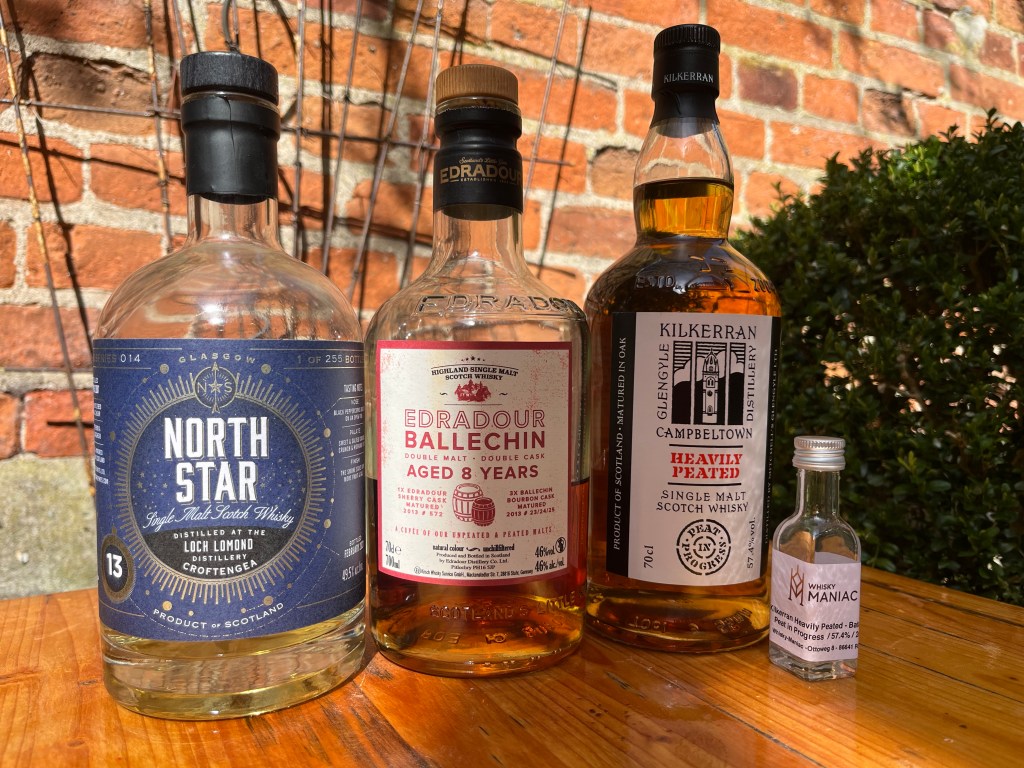
The isle of Islay is famous for its peaty whiskies. But there are both non-peaty Islay whiskies, and non-Islay peaty whiskies, not to mention non-Islay non-peated non-whiskies. Here I will review three bottles from my whisky cupboard that fall under the second heading. They come from three different most-of-the-time whisky regions of Scotland: Lowland, Highland, and Campbeltown.
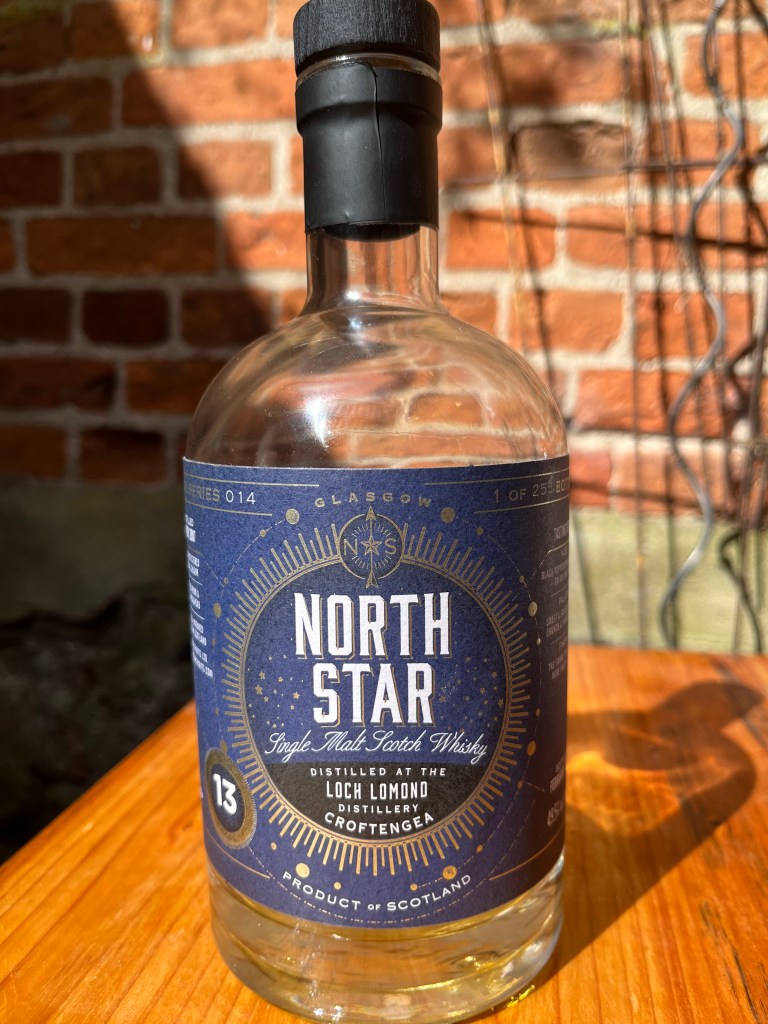
First we have an independently bottled Croftengea. This is the name that Loch Lomond distillery near Glasgow uses for its heavily peated single malt. Loch Lomond is a sort of Swiss army knife distillery, making grain whisky and malt whisky, peated and unpeated, all under a variety of labels. On site they have 11 stills of 4 different kinds.
My first Croftengea was an SMWS bottle dubbed “not for the faint-hearted” that tasted like lemongrass fried fish and smoke, which lead me to seek out a number of other Croftengeas, most of which turned out to be rather different but even lovelier, especially one by A.D. Rattray, combining citrus, minerality, and peat, in a distinctive way.
I bought the present bottle for €68,90, guided in my purchase by the official tasting notes which state: “Nose: black peppercorns roasting on an open fire. Palate: sweet & salted caramel crunch & highland peat. Finish: The smoke stays with more fruit and salt.” Doesn’t sound bad at all – but what do I taste?
Whisky review
Croftengea (Loch Lomond) 2007 13yo at 49.5%
by North Star Spirits
Natural colour • Un-chillfiltered.
Nose: first thought is buttered popcorn, then some black pepper, granite powder, heather, and a trace of sulphur. Not overwhelming, but there are fruits in there: certainly citrus (grapefruit and lime); perhaps also pear. The taste is salty, a little bitter, a little sweet; the peat and sulphur are prominent, but I also find canary melon and some other hard-to-pinpoint tropical fruits. The experience becomes a bit more forgiving with a teaspoon of water. The finish is surprisingly more fruit than peat oriented.
Verdict: not at all bad, but for my taste it’s a bit too sulphuric than it needed to be.
⭐Notable Quality • My WB Rating: 83
I’ve tried this Croftengea over many days for this review (beside drinking most of the bottle in the year past), and I’m surprised at how variable my impression of the amount of fruit notes present is: from very little a few days ago, to quite a lot today. When possible, I prefer to give a review averaged over several sessions for these reasons!
Next up for review is a Ballechin, the label that Edradour distillery uses for their peaty stuff. Edraduour was bought from drinks giant Pernod Richard in 2002 by the person behind the Signatory Vintage independent bottling firm. With its 260’00 litre capacity, the distillery is one of the smallest in Scotland, where distilleries typically have 10x or more that capacity.
What I’m reviewing today is an original bottling, which I point out, because, quite incestuously, there are “independently” bottled Edradours by Signatory Vintage. (Just like there are Cadenhead’s bottling of Springbank – but the other way around, as the latter owns the former… Okay, this is getting convoluted.) Here we we are dealing a vatting of 3 ex-bourbon casks of regular ol’ Ballachin, and one ex-sherry cask of regular ol’ Edradour, in a “cuvée” – oh, la, la! For this bottle I paid a facile €49,90.
Whisky review
Edradour / Ballechin 2013 8yo at 46%
Original Bottling
Vatting of 1x sherry (unpeated) and 3x bourbon casks (peated) • Natural Colour • Un-Chillfiltered

A modern-style sherry nose; then toasted nuts, dried fish flakes, and peat. Generous palate with salted caramel and ample but not overpowering peat; there’s burnt rubber and something “fishy” too, adding interest without becoming too odd (for me at least). The finish holds sherry, peat, and sesame seed oil, but is a bit metallic.
Verdict: a somewhat strange beast, but it keeps its elements together reasonably well.
⭐Notable Quality • My WB Rating: 84
Finally, we are off to the mystical town-cum-whisky-region of Campbeltown. In 1998, sporting but two operating distilleries, Springbank and Glen Scotia, SWA (the Scotch Whisky Association) decided to stop labelling Campbeltown as an official whisky region. This prompted the owner of Springbank to resurrect the old Glengyle distillery, and then there were three – just like in the Lowlands whisky region. So in 2004 SWA reintroduced Campbeltown as its own whisky region.
Confusingly, whisky from Glengyle distillery is called Kilkerran, named after Saint Keiran’s who in olden days founded a settlement in the location that is today Campbeltown. The name Glen Gyle is owned by Loch Lomond distillery who use it for their vatted malt.
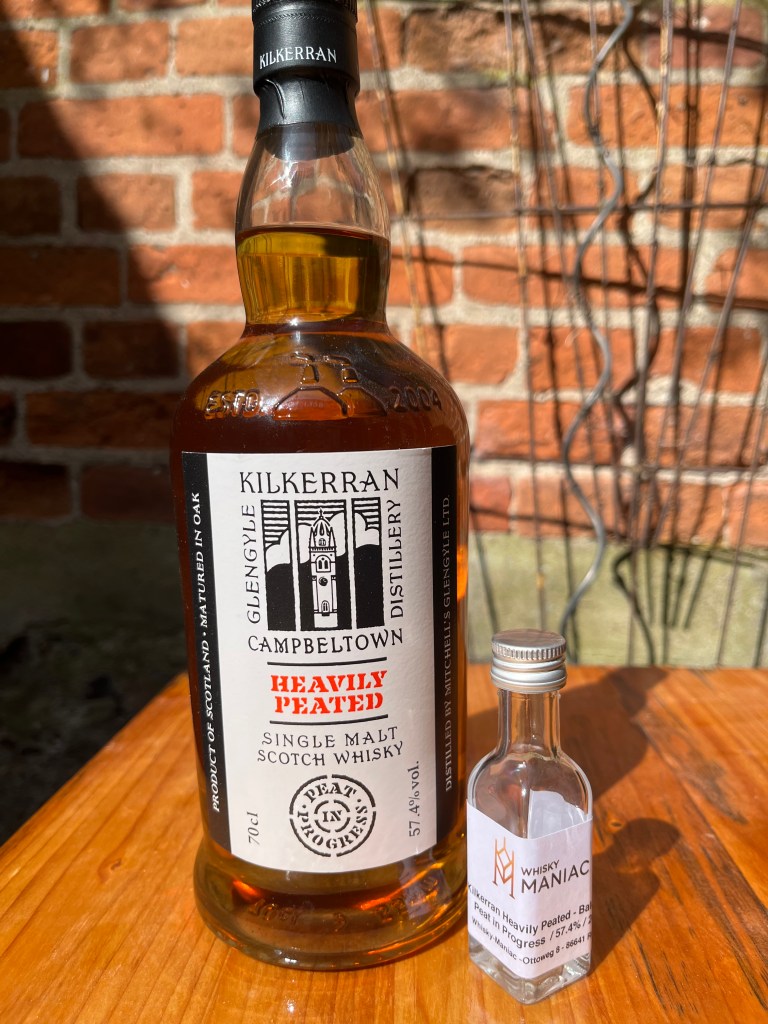
On hand today I have a “peat in progress” batch of Kilkerran with no age statement, and at a hefty cask strength of 57%. With a special Fringe £10-off coupon I snagged tis bottle for a next-to-nothing £30 quid at Royal Mile Whiskies. To boot I received a free 2cl sample of this whisky with an order from MaltManiac. Today I’ll review the sample – my bargain bottle remaining for the moment pristinely sealed. Saint Keiran hath truly bless’ed me.
Whisky review
Kilkerran “Heavily peated – batch 6” at 57.4%
Original Bottling
75% bourbon / 25% sherry casks Natural colour • Non-chillfiltered
My nose hairs are on fire – there is alcohol! Definitely yellow apples; also lemon grass and a smell of grilled seafood somewhere nearby; a generally minerally profile. A sulphur note is there but is relatively well masked. A lively and not very complex nose, betraying young spirit; but surprisingly little peat. Taste, however, offers sweet, warming peat, to which I might add stone fruits and ginger. I added a dollop of water to temper the high ABV, but this brought out more sulphur and bitterness, and was not an improvement to my taste. Long salty-sweet-smoky finish and a hint of cigar. As I smell the empty glass I get a whiff of that hay / farmyard character typical of Campbeltown malts.
Verdict: a lively and enjoyable dram, but not something I get too excited about.
⭐Notable Quality • My WB Rating: 84
Not at all unlike the NS Croftengea reviewed above, but definitely heavier peat. I imagine not too far from the SMWS Croftengea of years ago, but memory doth betray.
There we go, some non-Islay peat to stack up some competition for the many Islay drams I’m sure to sample in the Islay trip happening next week — whoop, whoop!

 DuckDrams
Leave a comment